

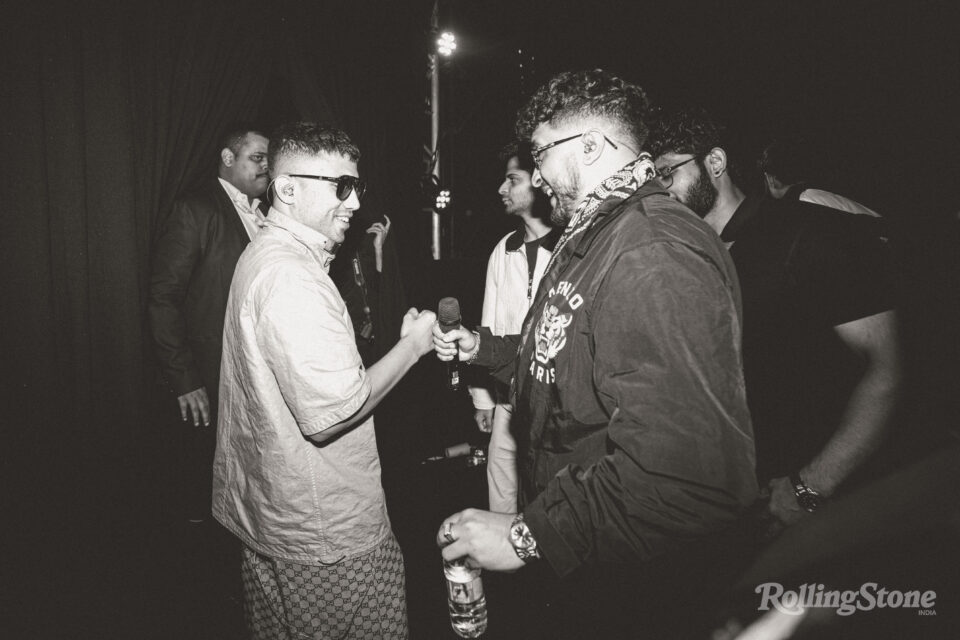
In a greenroom in Mumbai, ten languages are being spoken at once. Tamil trades places with Malayalam; a burst of Haryanvi cuts through Hindi; Meitei, Punjabi and Telugu rode the same drum check. More than thirty artists have come in from across the map for one moment — Spotify’s Rap91 live — and the room feels charged, like a new center of gravity. You can tell by the shorthand. Someone yells “Macha,” another answers “Bhau,” a third cracks a Meitei joke that only half the room understands. The rest laugh anyway. That’s the point of Rap91: India no longer needs translation to feel connected.
Starting in the south, Kerala’s Malayalam spearhead has become impossible to ignore. ARJN, KDS, GABRI, M.H.R., and Tamil rapper JOKER390P came in like a unit — a pocket of swagger that’s already spilling out of Kochi clubs and Malappuram WhatsApp groups into national timelines. Their recent Def Jam runs have been almost territorial, proud of the cadence and wordplay that only Malayalam lets you pull off. ARJN and KDS’ back-to-back drops (“Sheriya,” “Nera”) have basically become calling cards for the scene, with YouTube titles saying the quiet part loud: “Latest Malayalam Rap Song.” GABRI’s momentum — from “Naranga Paal” to Red Bull 64 Bars — is a reminder that Kerala’s storytellers don’t need a gateway city anymore; they have their own. And when M.H.R and JOKER390P locked in for “Munthirichar,” the clip did what strong regional music always does: it traveled. Not despite the language — because of it.

Slide along the coast to Tamil Nadu, and you meet two parallel forces. There’s Asal Kolaar — Chennai’s breakout star with the kinetic hooks that made “Jorthaale” a street phrase and kept the city’s rap pulse thumping through film, cyphers, and stages. There’s also RANJ (Ranjani Ramadoss), the Chennai-bred and now Mumbai-based rapper and singer who toggles between English and Tamil like it’s muscle memory. Along with close collaborator Clifr, she represents a southern hybrid that’s comfortable in R&B, rap, and everything between.
Telugu rap’s flag is firmly planted by Dasagriva, a Gully Gang battering ram who wears his HYD loyalties on the timeline and in the tags; his Telugu staccato feels built for arena call-and-response.

Now cut North and you hit the Hindi belt and its neighbors — the broadest, loudest, most hotly debated battleground. Start with Delhi, where Seedhe Maut showed the country a long time ago that you could build a national cult without moving to Mumbai. Calm and Encore ABJ have taken the scenic route: Azadi Records breakouts, then fully independent under their own label DL91, and now elder statesmen who still rap like the new kids are watching them. The DL91 umbrella is the clearest picture of Delhi’s current machine: Hurricane (producer-rapper, switching between English and Hindi), Ab 17, Bhaskar, Lil Bhavi, GhAatak, and OG Lucifer — a crew comfortable with mixtapes, midnight drops, and that DIY promotion grind. Their DL91FM project reads like a family photo of the capital right now.
Zoom west and the Haryanvi wave arrives with its shoulders up. KD DESIROCK is the OG reference point and remains a cultural north star for a lot of kids in Rohtak, Jind, Hisar, and across the state. Addy Nagar, who has bounced between Delhi-NCR and independent circuits, toggles Haryanvi and Hindi with ease and an ear for viral hooks.
Punjabi rap, meanwhile, keeps multiplying formats. Jaskaran brings a contemporary Punjabi cadence that sits comfortably next to Toronto playlists yet still smells of Ludhiana studio smoke; the Mass Appeal backing has added air under those choruses without sanding off the edge. Punjab-born Param is the quieter operator on this list — less algorithm, more word-of-mouth — but her sets hit home with the diaspora in the crowd. Meanwhile, Meaow, who hails from Himachal Pradesh but has carved a lane for herself through Hindi, English, and Punjabi rap, carries that Nicki Minaj-type je ne sais quoi. Meaow may be newer to national readers than KD, but inside the belt, they’re both just as recognizable as a license plate. Meaow and KD prove something simple: if your bars feel like your district, your district will carry you.

Head due east, and the map splits again. Reble — Shillong, Meghalaya — doesn’t just represent the Northeast; she treats the mic like a place to reclaim silence, running English heavy but bending phrasing in ways that carry Khasi cadence without announcing it. Her press lately has spelled it out: Shillong-raised, Northeast-first, not here to play safe. Kim The Beloved, who has ties across Shillong and Aizawl, rides snarling club tempos and grimy pockets with straight-faced clarity; when he says “Gass Dat,” the vowels land like a hook. And then there’s Yelhomie — Manipur’s sharp conscience — who flips between Meitei and English with punchlines that feel like news tickers. If you didn’t know Imphal could produce rap like this, that’s on your algorithm —not on him.

Some artists in this cohort live between states, streams, and screens. Vichaar was born in Uttarakhand, cut his teeth in Dehradun’s underground, writes in Hindi and English, and treats visuals like second verses; Uniyal also carries Devbhoomi in his name and references, leaning into Hindi with hints of pahadi grit; Karma is Dehradun’s export with a national footprint, a Hindi specialist whose pen keeps sharpening even as the venues get bigger. The Uttarakhand-to-Delhi pipeline is one of the scene’s least told stories — a flow of kids who grew up on mountains, learned their timing in capital-city cyphers, and now headline metros.
There’s the NCR and Hindi mainstream where anchors like Ikka still matter — a New Delhi stalwart whose career arc maps the genre’s arc, from underground to Bollywood features to rap-first albums, without losing the Delhi swagger in his delivery. Uniyal, Vichaar, Karma, Ikka, and the DL91 lot sketch a North India that’s bigger than one city and more varied than one slang.

Mumbai hasn’t gone anywhere; it just got busier. Yung DSA out of the Gully Gang system swings between Marathi and Hindi and keeps stacking live miles across Maharashtra —a reminder that 2016’s gullies now include Pune lanes and Nashik terraces. Downriver, Nagpur has skin in the game too: Naam Sujal, a Def Jam India wildcard with a Hustle-honed stage instinct, literally writes his city into the track titles — “3 AM in Nagpur” is geography as a thesis statement.
The Hindi-forward independents round out the picture. Shikriwal and Pho are the kind of names you see first on flyers and then on Discover Weekly: Bhojpuri and Hindi storytellers with different meters, bringing NCR slang and small-town detail to hooks that don’t ask for permission. Vaibhav (Hindi; Believe) is in that camp too — a streaming native with melody instincts and just enough grit to cut through the week’s new-music dump. Hurricane glues a lot of this together from the production side, and when he raps, he slips into English/Hindi fluently; on DL91FM, he’s the gravitational center more than a featured guest.

There are cross-border and cross-format threads everywhere you look. RANJ x Clifr arrived repping Bengaluru’s live ecosystem even as RANJ’s bio keeps her Chennai roots front and center. That duality mirrors how many in this lineup move — city to city, label to label, language to language. Kim The Beloved can be in a Mumbai video cycle on Friday and back in the Northeast calendar by Tuesday. Young Aytee came up Dehradun-bred while still dropping Hindi hooks that land in Delhi clubs, proof that “regional” can be a feeling, not just a pin on Google Maps.

And then there’s the label chessboard, which, when you zoom out, looks less like rivalry and more like overlapping ecosystems. Def Jam Recordings India has clearly invested in Kerala’s ascent — that’s where a good chunk of the Malayalam surge is housed right now. Gully Gang stays busy turning local slang into national anthems (and giving Telugu a bullhorn via Dasagriva). Mass Appeal India has staked out a cross-regional lane that runs from Punjabi (Jaskaran) to North Indian hybrids (Young Aytee, vichaar, Yelhomie). Azadi Records continues to be the place where English-forward experimentation and activist roots meet — Reble, Kim The Beloved, Clifr and RANJ have all touched that orbit. DL91 feels like the capital’s independent answer to label consolidation — a hub for Seedhe Maut, Hurricane, Ab 17, Bhaskar, Lil Bhavi, GhAatak, and OG Lucifer to move like a unit while keeping their solo identities.
What threads this lineup together, beyond geography and streaming numbers, is the decision to build identity into the music. ARJN, KDS, GABRI, M.H.R., JOKER390P don’t treat Malayalam as a constraint; they treat it like a superpower. Asal Kolaar’s Tamil is its own instrument. Dasagriva turns Telugu consonants into percussion. Yelhomie uses Meitei to carry the weight English can’t. Jaskaran and Param carry Punjabi with an eye on global stages without outsourcing flavor. The Hindi field — from Seedhe Maut, Karma, Ikka, Ab 17, Bhaskar, Lil Bhavi, GhAatak, OG Lucifer, Shikriwal, Pho, Vaibhav, Uniyal (Garhwali, Hindi, and English), Vichaar, Young Aytee, Yung DSA (Marathi and Hindi) — is not one thing. It’s a dozen micro-dialects, a dozen social contexts, a dozen ways to make a crowd lean in.

On stage, that diversity hits like a reflex. A Tamil hook melts into a Delhi double-time, which spills into a Punjabi chant, and drops out so a Meitei bar can ring for a beat longer than usual. You see it in the pits too: a Haryanvi chorus yelled by kids from Andheri; a Malayalam punchline caught by a Shillong crew who learned it from reels. The old fear that language would keep Indian rap segmented feels laughable in a room like this.
Spotify’s Rap91 journey mirrors that same expansion. What began as a flagship playlist spotlighting Indian hip hop’s multilingual heartbeat has evolved into one of the 10 most-followed rap playlists on Spotify globally — proof that the genre’s reach is no longer confined to cities or languages. In just the past year, Rap91’s audience has grown by more than 60 per cent, adding over 150,000 new followers, with its regional offshoots — from Haryanvi and Malayalam to Punjabi and Marathi — collectively crossing 1.5 million followers. That kind of growth doesn’t just reflect a fandom; it signals a culture that’s now being streamed, shared, and staged at scale.

None of this says the job is done. Regional touring still needs routes. Brand money still favors metros. Too many artists have to design their own rollouts, book their own videographers, and argue for their own fees. But this Rap91 frame — one photo, dozens of stories — is proof that the talent isn’t scattered anymore; it’s networked. Spotify’s own arc with Rap91 backs that up: from playlist to platform to a live movement that deliberately lifts languages most mainstream calendars overlook. And the press tells the same story if you’re paying attention.

If you want to understand this moment, stop asking which city “owns” Indian hip-hop. The answer, finally, is boring and perfect: everyone. Tamil. Malayalam. Haryanvi. Hindi. Punjabi. Telugu. Meitei. English. The point isn’t that they share a stage. The point is that the stage sounds like them.
Advertisement in partnership with Spotify.
Executive Editor: Shamani Joshi
Creative Director: Peony Hirwani
Creative & Executive Producer: Dushyant Tak
Production Manager: Lakshay Malik
Art Director: Apoorva Singh
First Videographer: Gaurav Kumar
Second Videographer: Dhruv Tiwari
Video edit (Offline + Online): Gaurav Kumar
Designer: Ryan Chatterjee
Editorial Interns: Sharanyaa Nair and Shrada Raul
Production House: Dushyant&Co.


Leave a Reply