


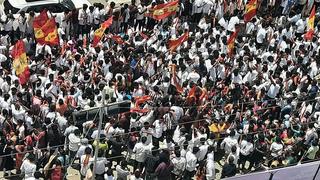
A crowd during a TVK political rally in Karur district.
| Photo Credit: MOORTHY M
The recent tragic crowd crush in Karur, during actor-politician Vijay’s rally that left 41, including nine children dead, is another in the many instances in the country where massive crowds have led to the deaths of people. A number of such deaths that occur are due to people being in a situation where they are not able to get enough oxygen into their bodies, leaving them unable to breathe. This particular form of asphyxiation that occurs in a crowd, is known as compressive asphyxia. Here is all you need to know about it.

What is asphyxia?
Asphyxia or asphyxiation occurs when the body does not get enough oxygen. Respiration is the process of air moving in and out of your lungs. Humans take in oxygen, which is circulated to all of the cells throughout the body via the blood, and carbon-di-oxide is then removed through the same system. When asphyxia occurs, and the body does not get the amount of oxygen it needs, it can cause a person to become unconscious or even die.
Also Read:An avoidable tragedy: On the TVK rally, the stampede in Karur
What are the types of asphyxia?
There are various classifications of asphyxia. The Cleveland Clinic’s website lists the following types:
Mechanical asphyxia: This is when an object or physical force stops you from breathing or the body is in a position that does not allow it to breathe.
Traumatic asphyxia: A type of mechanical asphyxia where a strong external force (trauma) to the thoracic cavity causes traumatic asphyxiation, forcing blood from the heart back through the veins to the neck and brain.
Perinatal (birth) asphyxia: This occurs when a baby doesn’t get enough oxygen right before, during or right after birth.
Compressive (compression) asphyxia. Compression asphyxiation is also type of mechanical asphyxiation. A strong external force presses on your chest or abdomen. Examples include a large crowd pushing against your body or someone sitting or kneeling on the chest.
Other classifications include suffocation: due to the obstruction of the respiratory orifices or inadequate amount of oxygen in the environment; chemical asphyxia when chemicals prevent oxygen from reaching the body’s cells; strangulation and drowning.

How does compressive asphyxia occur?
In large crowds or stampede situations, there is no room to move. People are often crushed against one another, placing immense pressure on the chest. This means the diaphragm (muscle that separates the thoracic cavity from the abdominal cavity) which plays a major role in respiration, is unable to contract and flatten, leaving the body unable to breathe in and breathe out air. When this happens, there is insufficient oxygen and also a build-up of carbon-di-oxide in the body. Since the human body cannot function without oxygen, this can lead to organ failure and death.

What level of crowds impact breathing?
The upper limit when it comes to crowd density, which is the number of people per square metre, in general, is five people per square metre. Crowds in excess of six or seven people per square metre can hamper movement and potentially breathing, leading to a high risk situation. The U.K.’s Green Guide to Safety at Sports Grounds states 47 persons per 10 square metres (4.7 per square metre) should be the maximum number to calculate the capacity of standing areas at sports grounds.
Even before a stampede occurs however, a massive congested crowd can lead to oxygen deprivation (hypoxia) and carbon-di-oxide level increases (hypercapnia), triggering respiratory distress.

How to stay safe in a crowd?
Among recommendations to stay safe in a crowd are: doing your homework on the venue, checking the weather forecast for excess heat, rain or other weather events, going with a partner, being aware of your surroundings, ensuring you have a safe meeting point in case of separation and lack of mobile phone service, wearing brightly-coloured clothes, finding all the exit points and mapping out a route to them, holding on to railings for support where required, moving diagonally and sideways to the edge of the crowd to get to an open space, and importantly, leaving early if the situation feels risky.
Published – October 03, 2025 04:44 pm IST


Leave a Reply